

BDA Module 1: Introduction to Big Data
LECTURE 1: INTRODUCTION TO BIG DATA
Q1. Explain Big Data.
Big Data refers to extremely large and complex datasets that are generated at a very high speed and cannot be efficiently processed using traditional data processing systems such as relational databases. As digital technologies have advanced, data is being produced continuously from multiple sources, making it difficult for conventional systems to store, manage, and analyze it effectively.
The data becomes “Big Data” when its size, speed of generation, or complexity exceeds the capacity of traditional systems. Earlier systems were designed to handle structured data in limited volumes, whereas Big Data includes structured, semi-structured, and unstructured data such as text, images, videos, and sensor data. This data is generated from online transactions, social media platforms, mobile devices, scientific experiments, and IoT sensors.
Big Data plays a crucial role in modern organizations because it enables advanced analytics and data-driven decision-making. By analyzing Big Data, organizations can identify hidden patterns, predict trends, and gain deeper insights into customer behavior and business operations.
Thus, Big Data is not only about handling large volumes of data, but also about extracting meaningful value from it using specialized tools and technologies.
Q2. Explain data size units used in Big Data.
In Big Data analytics, data is measured using hierarchical storage units that represent increasing volumes of data. The smallest unit of data is a bit, and eight bits together form one byte. As data volume increases, larger units are used to represent it efficiently.
One kilobyte (KB) is equal to 1024 bytes, while one megabyte (MB) consists of 1024 kilobytes. Similarly, one gigabyte (GB) equals 1024 megabytes and one terabyte (TB) equals 1024 gigabytes. In Big Data environments, data is commonly measured in much larger units such as petabytes (PB), exabytes (EB), zettabytes (ZB), and yottabytes (YB).
Modern applications such as social media platforms, cloud services, and scientific research generate data at petabyte and exabyte scales. Traditional data processing systems struggle to handle such massive volumes, which is why Big Data technologies are required.
Hence, understanding data size units is essential to appreciate the scale and challenges associated with Big Data.
Q3. Explain the sources of Big Data.
Big Data is generated from a wide range of sources in today’s interconnected digital environment. One major source of Big Data is banking and credit card transactions, where millions of financial records are generated every second. These transactions include payments, transfers, and online purchases.
Another significant source is social media platforms such as Twitter, Facebook, and Instagram. These platforms generate enormous amounts of unstructured data in the form of posts, comments, images, and videos. Web and e-commerce systems also contribute heavily by recording user clicks, searches, browsing behavior, and purchase histories.
Additionally, mobile devices, sensor technologies, and Internet of Things (IoT) networks generate continuous streams of real-time data. Scientific instruments and research experiments also produce large datasets that require Big Data processing techniques.
Therefore, the variety and volume of data sources contribute to the rapid growth of Big Data across industries.
Q4. Why is Big Data important?
The importance of Big Data lies not in the volume of data generated, but in how effectively it is analyzed and utilized. Big Data enables organizations to make better and faster decisions by analyzing large datasets and identifying meaningful patterns and trends.
By using Big Data analytics, businesses can improve operational efficiency by optimizing processes, reducing costs, and minimizing risks. Big Data also enhances customer experience by enabling personalized recommendations, targeted marketing, and improved services.
In sectors such as healthcare and finance, Big Data helps in early disease detection, fraud prevention, and risk analysis. Governments and organizations also use Big Data for traffic management, security, and policy planning.
Thus, Big Data is a powerful asset that drives innovation, efficiency, and competitive advantage in modern organizations.
LECTURE 2: BIG DATA CHARACTERISTICS AND TYPES
Q5. Explain the types of Big Data.
Big Data is broadly classified into three categories based on its structure and organization, namely structured data, unstructured data, and semi-structured data. This classification helps in understanding how data is stored, processed, and analyzed.
Structured data refers to data that follows a fixed schema and is organized in rows and columns. It is usually stored in relational database management systems and can be easily queried using SQL. Examples of structured data include employee records, banking transactions, and inventory databases. Although structured data is easy to manage, handling it becomes challenging when the data size grows to extremely large volumes.
Unstructured data does not have a predefined format or schema. It includes data such as text documents, emails, images, videos, audio files, and system logs. This type of data constitutes the majority of Big Data generated today. Traditional databases are not well suited to store or analyze unstructured data, making it a major challenge for organizations.
Semi-structured data lies between structured and unstructured data. It does not follow rigid relational schemas but contains tags or markers to organize data elements. Common examples include XML and JSON files, which are widely used in web applications.
Thus, Big Data systems must be capable of handling all three types of data efficiently.
Q6. Explain the characteristics of Big Data. (Also as Explain the challenges of Big Data)
Very Important
Big Data is defined by five key characteristics commonly known as the 5 V's of Big Data. These characteristics distinguish Big Data from traditional data systems.
The first characteristic is Volume, which refers to the massive amount of data generated from various sources such as social media, sensors, and online transactions. Data today is generated in terabytes and petabytes, far exceeding the capacity of traditional systems.
The second characteristic is Velocity, which indicates the speed at which data is generated, transmitted, and processed. Examples include real-time data from stock markets, social media feeds, and IoT devices.
The third characteristic is Variety, which represents the different forms of data such as structured, semi-structured, and unstructured data. Handling such diverse data types is a major challenge in Big Data analytics.
The fourth characteristic is Veracity, which deals with the quality, accuracy, and reliability of data. Big Data often contains noise, inconsistencies, and uncertainty.
The fifth characteristic is Value, which refers to the ability to extract meaningful and useful insights from raw data. Without value, large volumes of data have no practical significance.
LECTURE 3: TRADITIONAL VS BIG DATA BUSINESS APPROACH
Q7. Differentiate between traditional data and Big Data.
Traditional data systems are designed to handle small to moderate volumes of structured data stored in centralized relational databases. These systems rely on fixed schemas and vertical scaling using powerful servers. They are mainly used for transactional processing and routine business operations.
In contrast, Big Data systems are designed to handle very large volumes of structured, semi-structured, and unstructured data. They use distributed storage systems such as HDFS and support horizontal scaling by adding more machines. Big Data systems operate on clusters of commodity hardware and are optimized for large-scale data analysis rather than simple transactions.
Traditional systems are limited in scalability and flexibility, whereas Big Data systems provide high scalability, fault tolerance, and cost effectiveness. Therefore, Big Data systems are better suited for modern analytics-driven applications.
Q8. Traditional analytics vs Big Data analytics.
Traditional analytics focuses on analyzing structured data using predefined queries and reports. The analysis process is usually repeatable and predictable, and data preparation is handled primarily by IT teams. Traditional analytics aims to answer known business questions based on historical data.
Big Data analytics, on the other hand, is exploratory and iterative in nature. It allows analysts and business users to explore large and diverse datasets to discover unknown patterns and insights. Big Data analytics supports advanced techniques such as sentiment analysis, behavioral analysis, and predictive analytics.
Unlike traditional analytics, Big Data analytics handles real-time and high-velocity data and enables organizations to adapt quickly to changing business conditions.
Q9. Traditional transactions vs Big Data transactions.
Traditional transaction systems are based on OLTP (Online Transaction Processing) models and are designed to handle structured transactional data. These systems follow ACID properties to ensure data consistency and reliability. Examples include order processing, billing, and payment systems.
Big Data transactions are generally non-transactional and focus on capturing high-velocity data generated from user interactions and system events. Examples include clickstream data, website activity logs, and shopping cart updates. Such data does not always require strict ACID compliance.
Thus, while traditional systems focus on accuracy and consistency, Big Data systems focus on scalability and real-time data processing.
LECTURE 4: CASE STUDIES OF BIG DATA SOLUTIONS
Q10. Explain applications and use cases of Big Data.
Big Data has a wide range of applications across various industries. In healthcare, Big Data is used for disease prediction, patient monitoring, and personalized treatment plans. In finance, it supports fraud detection, risk analysis, and algorithmic trading.
Retail and e-commerce companies use Big Data to create a 360-degree view of customers, enabling personalized recommendations and targeted marketing. Big Data is also used in security and intelligence to detect threats and suspicious activities. In operations analysis, organizations analyze machine and process data to improve efficiency and reduce downtime.
Big Data also supports data warehouse augmentation, where traditional data warehouses are enhanced with large and diverse datasets. These use cases demonstrate how Big Data transforms raw data into actionable insights.
LECTURE 5: CONCEPT OF HADOOP
Q11. What is Hadoop? Explain its motivation / Explain scalability in Big Data and Hadoop.
Hadoop is an open-source framework developed by the Apache Software Foundation for the distributed storage and processing of large datasets. It was created by Doug Cutting and Mike Cafarella in 2005 to address the challenges posed by rapidly growing data volumes.
Traditional data processing systems rely on centralized architectures and vertical scaling, which involve upgrading hardware to handle increased data. Such systems suffer from limited scalability, high costs, and poor performance when dealing with large and diverse datasets. As data volumes grew to terabytes and petabytes, these systems became inefficient and difficult to manage.
Hadoop was motivated by the need for a scalable and cost-effective solution for Big Data processing. It achieves scalability through horizontal scaling, where data and computation are distributed across multiple machines. New nodes can be added to the cluster as data grows, without disrupting existing operations. Hadoop also moves computation closer to data, reduces network overhead, and uses commodity hardware.
Thus, Hadoop provides a highly scalable, fault-tolerant platform suitable for Big Data workloads.
Q12. Explain Hadoop assumptions.
Hadoop is designed based on several key assumptions. One major assumption is that hardware failures are common, and therefore the system must be fault tolerant. Hadoop achieves this through data replication.
Another assumption is that Hadoop workloads are primarily batch-oriented, meaning it is optimized for processing large datasets rather than real-time transactions. Hadoop also assumes a write-once-read-many access pattern, where data is written once and read multiple times.
Hadoop is designed to handle very large datasets and supports horizontal scalability by adding more nodes. These assumptions guide the design and architecture of Hadoop.
LECTURE 6: HADOOP COMPONENTS AND ECOSYSTEM
Q13. Explain the core components of Hadoop.
Hadoop consists of four core components that work together to support distributed data processing. Hadoop Common provides shared utilities and libraries required by other Hadoop modules.
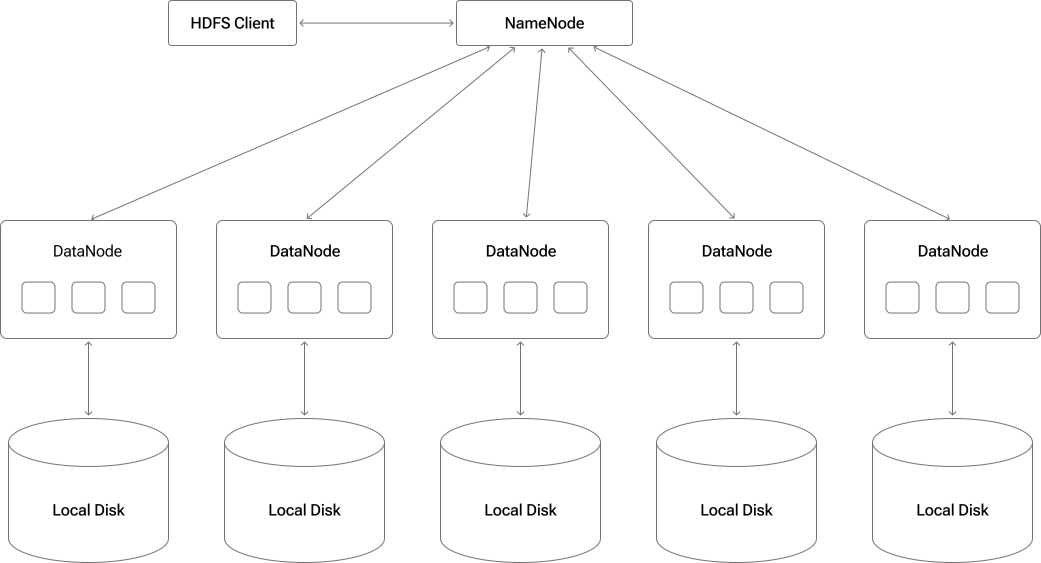
HDFS (Hadoop Distributed File System) is responsible for distributed storage. It splits large files into blocks and replicates them across multiple nodes to ensure fault tolerance. The NameNode manages metadata, while DataNodes store the actual data.
YARN (Yet Another Resource Negotiator) manages cluster resources and schedules jobs by allocating CPU and memory efficiently. MapReduce is the programming model used for distributed processing, where data is processed using Map and Reduce phases.
Q14. Explain HDFS.
HDFS is a distributed file system designed to store large datasets across multiple nodes in a Hadoop cluster. It divides files into fixed-size blocks and distributes them across DataNodes. Each block is replicated, typically three times, to ensure fault tolerance.
The NameNode maintains metadata such as file names, block locations, and permissions, while DataNodes handle the actual storage. HDFS is optimized for high throughput rather than low latency and is suitable for batch processing of large datasets.
Q15. Explain MapReduce.
MapReduce is a programming model used in Hadoop for processing large datasets in a distributed manner. It consists of three main phases: Map, Shuffle, and Reduce.
In the Map phase, input data is processed and converted into intermediate key-value pairs. The Shuffle phase sorts and redistributes these pairs based on keys. In the Reduce phase, the data is aggregated to produce the final output.
MapReduce enables parallel processing and fault-tolerant computation across large clusters.
Q16. Explain the Hadoop ecosystem.
The Hadoop ecosystem consists of tools that extend Hadoop's capabilities. Hive provides SQL-like querying for large datasets, while Pig offers a high-level scripting language for data transformation. HBase is a NoSQL database that supports real-time read and write operations.
Sqoop is used to transfer data between Hadoop and relational databases, and Flume is used for log and data ingestion. Mahout supports machine learning applications, and ZooKeeper provides coordination and synchronization services.
Together, these tools make Hadoop a complete Big Data processing platform.
Q17. Why Hadoop?
Hadoop is preferred for Big Data processing because it is highly scalable, allowing organizations to add more nodes as data grows. It is cost effective since it runs on commodity hardware. Hadoop provides fault tolerance through data replication and automatic recovery.
It supports distributed storage and processing, making it suitable for handling massive datasets. Therefore, Hadoop is widely used for Big Data workloads in modern enterprises.
Q18. Why do traditional systems fail for Big Data?
Traditional data processing systems are designed to handle small to moderate volumes of structured data using centralized architectures. As data grows in size, speed, and complexity, these systems become inefficient and difficult to scale.
Traditional systems rely on single-server or vertically scaled architectures, which require expensive hardware upgrades to handle increased data volumes. They are optimized for structured data stored in relational databases and struggle to manage semi-structured and unstructured data such as text, images, and logs. Additionally, traditional systems provide limited fault tolerance, meaning hardware failures can lead to data loss or system downtime.
Big Data requires distributed storage, parallel processing, and high scalability, which traditional systems are not designed to support. Therefore, traditional systems fail to efficiently store, process, and analyze Big Data.
Q19. Batch processing vs Real-time processing (High-level comparison)
Batch processing and real-time processing differ mainly in how and when data is processed. Batch processing involves collecting large volumes of data over a period of time and processing it together as a single job. It is optimized for high throughput and is commonly used for historical data analysis, reporting, and large-scale analytics.
Real-time processing, on the other hand, processes data immediately as it is generated. It is designed for low latency and quick responses, making it suitable for applications such as fraud detection, live monitoring, and real-time alerts.
Hadoop is primarily designed for batch processing, as it focuses on processing massive datasets efficiently rather than providing instant responses. Real-time systems prioritize speed, while batch systems prioritize scalability and accuracy over large datasets.
Q20. Explain the concept of fault tolerance in Hadoop.
Very Important
Fault tolerance refers to the ability of a system to continue functioning correctly even when hardware or software failures occur. In large distributed systems like Hadoop, hardware failures are expected rather than exceptional.
Hadoop achieves fault tolerance mainly through data replication and task re-execution. In HDFS, each data block is replicated across multiple DataNodes so that if one node fails, the data can still be accessed from another node. The NameNode monitors the health of DataNodes and ensures data availability.
In MapReduce, if a task fails due to node failure, Hadoop automatically reassigns the task to another node. This automatic recovery mechanism ensures reliable processing without manual intervention, making Hadoop highly fault tolerant.